Why "nonman"/"nonwoman" is harmful language:
"Nonman" and "nonwoman" have been rising in popularity as terminology among the younger queer community in an attempt to redefine lesbianism and homosexuality. The usage of "nonman" and "nonwoman" has served to push nonbinary into a binary of not-man aligned/not-woman aligned, excluding and alienating multigendered nonbinary folk who are both man-aligned and woman-aligned.In addition to this binarist way of viewing gender, "nonman" and "nonwoman" have history in colonialist, antiblack and anti-Indigenous views to emasculate men and masculinize women, along with othering intersexuals who did not live in a binary way.
Evidence of "nonman"/"nonwoman" being antiblack language:
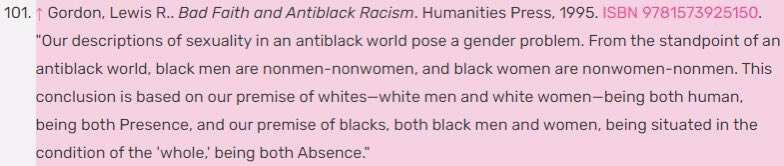
101. ↑ Gordon, Lewis R.. Bad Faith and Antiblack Racism. Humanities Press, 1995. ISBN 9781573925150.
"Our descriptions of sexuality in an antiblack world pose a gender problem. From the standpoint of an antiblack world, black men are nonmen-nonwomen, and black women are nonwomen-nonmen. This conclusion is based on our premise of whites-white men and white women-being both human. being both Presence, and our premise of blacks, both black men and women, being situated in the condition of the 'whole,' being both Absence."
Evidence of "nonman"/"nonwoman" being anti-Indigenous language:
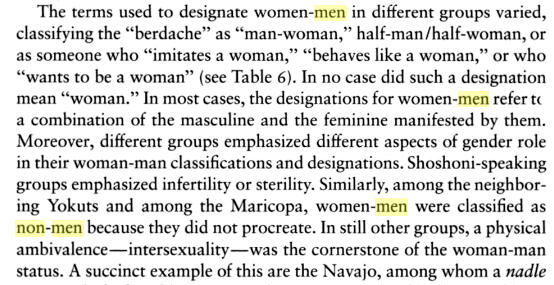
247. ↑ Lang, Sabine.. Men as Women, Women as Men: Changing Gender in Native American Cultures
The terms used to designate women-men in different groups varied, classifying the "berdache" as "man-woman," half-man/half-woman, or as someone who "imitates a woman," "behaves like a woman," or who "wants to be a woman" (see Table 6). In no case did such a designation mean "woman." In most cases, the designations for women-men refer to a combination of the masculine and the feminine manifested by them. Moreover, different groups emphasized different aspects of gender role in their woman-man classifications and designations. Shoshoni-speaking groups emphasized infertility or sterility. Similarly, among the neighboing Yokuts and among the Maricopa, women-men were classified as non-men because they did not procreate. In still other groups, a physical ambivalence-intersexuality-was the cornerstone of the woman-man status.

101. ↑ Lang, Sabine.. Men as Women, Women as Men: Changing Gender in Native American Cultures
“if the work proved too much for the women" were old men (1965:132) who were too weak to go on hunts or on raids anymore. Feminine occupations, therefore, were in principle open to women, non-men, and no-longer-men.
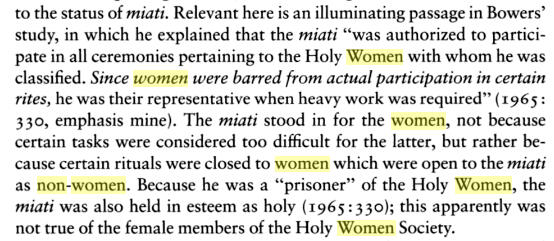
101. ↑ Lang, Sabine.. Men as Women, Women as Men: Changing Gender in Native American Cultures
Relevant here is an illuminating passage in Bowers' study, in which he explained that the miati "was authorized to participate in all ceremonies pertaining to the Holy Women with whom he was classified. Since women were barred from actual participation in certain rites, he was their representative when heavy work was required" (1965: 330, emphasis mine). The miati stood in for the women, not because certain tasks were considered too difficult for the latter, but rather because certain rituals were closed to women which were open to the miati as non-women. Because he was a "prisoner" of the Holy Women, the miati was also held in esteem as holy (1965:330); this apparently was not true of the female members of the Holy Women Society.
This last piece of evidence shows how "nonman"/"nonwoman" is not only anti-Indigenous, but also intersexist language:

247. ↑ Lang, Sabine.. Men as Women, Women as Men: Changing Gender in Native American Cultures
women - men were classified as non - men because they did not procreate. In still other groups, a physical ambivalence - intersexuality - was the cornerstone of the woman - man status.